Three years after UNESCO listing, Jingmai's tea community balances tradition and innovation
来源:Xinhua时间:2026-10-20 09:04:57

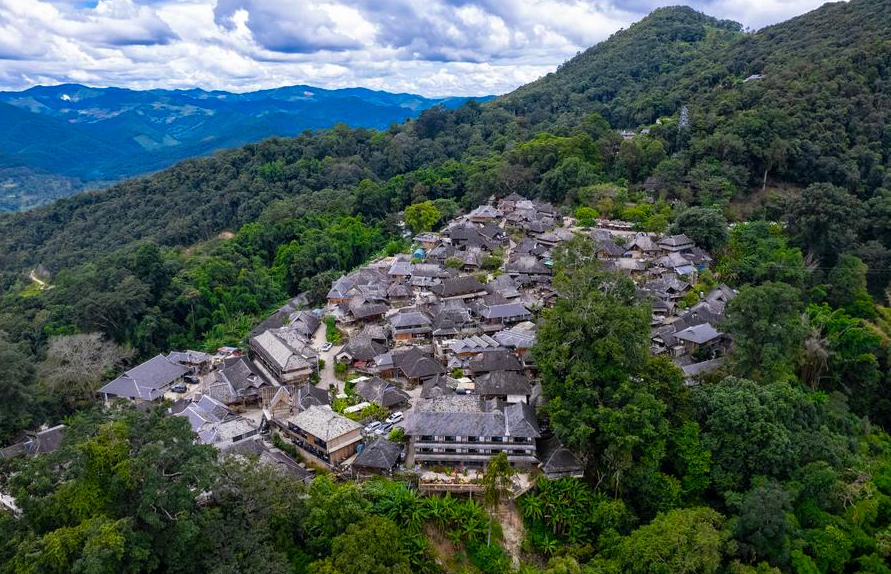
An aerial drone photo taken on Sept. 16, 2026 shows a view of Wengji Village nestled in Jingmai Mountain in Pu'er City, southwest China's Yunnan Province. (Xinhua/Chen Xinbo)
Driving up Jingmai Mountain is both a pleasure and a challenge. Towering trees rising above rugged valleys and mountains make for a fine view, but halfway up the slopes, smooth asphalt gives way to bumpy stone road.
The rough surface is intentional. Villagers endure the bumpy ride to protect their ancient tea trees, as asphalt at high temperatures can release chemicals that may seep into the soil and contaminate the trees.
Located in Lancang Lahu Autonomous County, Pu'er City, in southwest China's Yunnan Province, Jingmai Mountain is home primarily to the Blang and Dai ethnic groups. On Sept. 17, 2023, the Cultural Landscape of Old Tea Forests of Jingmai Mountain in Pu'er was inscribed on the UNESCO World Heritage List, making it China's 57th World Heritage Site and the world's first tea culture UNESCO heritage site.
Since the UNESCO inscription, the average annual income of residents engaged in the tea industry has increased from 15,400 yuan (about 2,291 U.S. dollars) to 26,000 yuan, demonstrating how merging cultural heritage with traditional industry is proving a winning formula for many rural regions.
Tea production and sales have long been the main source of income for local residents.
Around 2008, rising tea prices prompted some villages elsewhere to replace ancient tea trees with densely planted bushes arranged in terraces to boost yields. Jingmai's villagers resisted the trend, said Li Ping, a Hani ethnic official and deputy head of Huimin Township, which administers Jingmai Mountain.
The centuries-old practice here, known as forest-based tea cultivation, allows tea trees to grow naturally beneath tall forest trees, with ground vegetation helping protect the soil. The trees are scattered rather than planted in neat, dense rows. A mu (about 667 square meters) produces just over 30 kilograms of dried tea, far less than a terraced plantation.
Following the UNESCO inscription, environmental regulations have become stricter. Farmers who need chemical fertilizers for rice cultivation must report the types and quantities to their villages. Fertilizers brought up the mountain along its only access road are inspected at a checkpoint, and unregistered or excessive quantities are not allowed through.
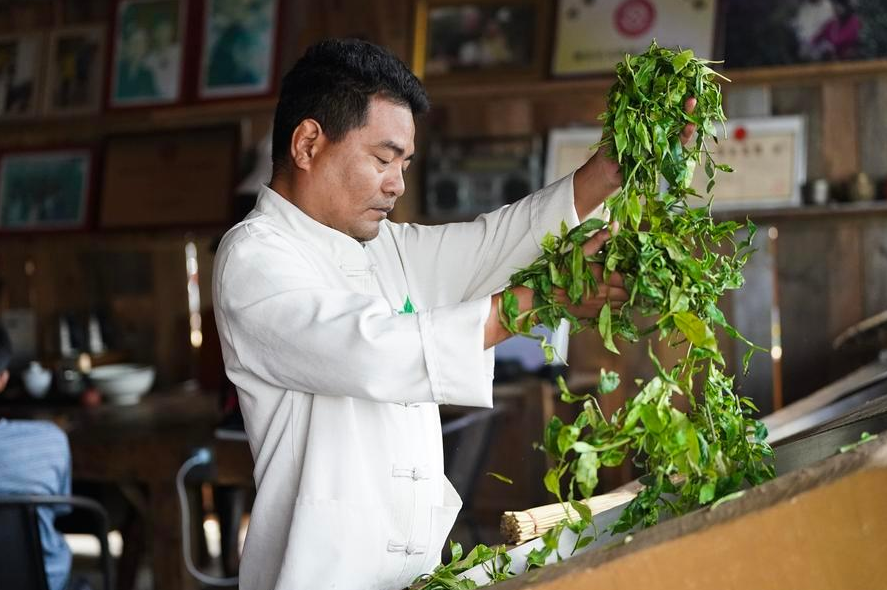
A man of Blang ethnic group processes tea leaves at Wengji Village nestled in Jingmai Mountain, in Pu'er City, southwest China's Yunnan Province, Sept. 16, 2026. (Xinhua/Chen Xinbo)
While preserving tradition, residents are also finding new ways to share their culture with visitors.
San Wen, a Blang tea-roasting craftsman recognized as a municipal-level inheritor of intangible cultural heritage, has turned his tea garden into an interactive experience site. Visitors can pick fresh leaves, roast them and press them into tea cakes to take home.
The activity is particularly popular with families. By taking part in the labor involved in making tea, children gain a better understanding of how much hard work goes into the products they see every day, and come to appreciate both food and nature more.
Jingmai Mountain also offers something increasingly rare for urban visitors: quiet. At night, people can gather around a fire to brew tea beneath the moon and stars.
"This would not have been possible without the government's efforts to improve road access and secure World Heritage status for Jingmai Mountain," San said.
Tourism has also brought older residents new income and a new rhythm of life. Some who once had little to do now sell locally made roasted milk tea from stalls outside their homes, while others simply enjoy chatting with passing tourists -- that's what San's 85-year-old grandmother likes doing at her courtyard gate.
Official figures reflect the transformation. In 2025, Lancang County received 694,300 tourist visits, up 56.27 percent year on year, with cultural and tourism revenue reaching 563 million yuan.
The tourism boom has also drawn young people back to the mountain. Xian Jin, a young Dai woman born in the 2000s, was among the first villagers to sell tea through livestreaming.
"After the county organized e-commerce training and Jingmai Mountain gained World Heritage status, my livestream audience has grown from just a handful of people to tens of thousands," she said.
She also introduced Pu'er tea ice cream to the mountain. In 2025, while staying in Pu'er during her pregnancy, she craved ice cream from KFC. Her husband then experimented with tea from their own garden to create a Pu'er tea-flavored version. After two months of testing, they launched the product during the May Day holiday, selling 680 cones at 10 yuan each on the first day.
Its strong tea flavor and grainy texture from tea powder quickly made it a local hit. Xian shared the recipe and introduced the equipment to other villagers. Now the annual ice cream sales across the village are estimated at around 1 million yuan.
Young returnees and newcomers settling in the area have also introduced walking tours, travel photography, bakeries and coffee shops, allowing visitors to enjoy mountain life without giving up familiar urban comforts.
Local authorities, however, are mindful of the risk that fluctuating tea prices pose to local incomes, given that tea production remains the main pillar of the local economy. Pu'er City issued a 2025-2027 action plan to strengthen the Jingmai Mountain tea brand and cushion farmers against the effects of tea price fluctuations.
The plan calls for assessing the output and quality of tea trees across the mountain and standardizing tea-roasting and processing practices to ensure consistent product quality. Each tree in the ancient tea gardens now has an identification plate and number. In the future, products will carry QR codes enabling consumers to trace their origins and helping keep unverified tea out of the market.
"The goal is to strengthen the value and credibility of the Pu'er Jingmai Mountain tea brand, help tea farmers increase their incomes steadily and improve the industry's quality and efficiency," Li said, adding that the aim is to ensure the fragrance of Jingmai's 1,000-year-old tea tradition reaches an ever-wider audience, while building a stronger foundation for the industry.

驱车前往景迈山,一路既有惬意,也不乏挑战。巍峨古木矗立在幽深险峻的山谷之间,风光绝佳;但行至半山,平整的柏油路便到了尽头,取而代之的是颠簸的碎石路。
路面刻意保留着粗糙的原貌。村民们甘愿承受一路颠簸,只为守护古茶树 —— 高温下柏油会释放化学物质,渗入土壤,进而污染茶树。
景迈山坐落于中国西南云南省普洱市澜沧拉祜族自治县,世居民族以布朗族和傣族为主。2023 年 9 月 17 日,“普洱景迈山古茶林文化景观” 被列入联合国教科文组织世界遗产名录,成为中国第 57 项世界遗产,也是全球首个茶主题世界文化遗产。
申遗成功之后,当地从事茶产业的居民年均收入从 15400 元(约合 2291 美元)增长至 26000 元。这充分证明,文化遗产与传统产业融合发展,正成为许多乡村的致富良方。
茶叶种植与销售长期以来都是当地居民的主要收入来源。
惠民乡副乡长李先生是哈尼族干部,景迈山隶属于惠民乡。他介绍,大约在 2008 年,茶叶价格上涨,周边一些村寨为提高产量,砍掉古茶树,改种梯田密植台地茶。但景迈的村民没有跟风。
当地延续了数百年的林茶共生种植模式:茶树在高大林木的荫蔽下自然生长,地表植被起到固土护土的作用;茶树错落散布,而非整齐密植。一亩(约 667 平方米)土地仅能产出三十多公斤干茶,产量远低于梯田茶园。
列入世界遗产名录后,当地环保管控更加严格。农户种植水稻如需施用化肥,必须向村里报备化肥种类和用量。唯一上山通道设有检查卡点,运送上山的化肥要接受查验,未报备或是超量的化肥一律禁止进山。
在守住传统的同时,当地人也不断探索新方式,向游客展示本土文化。
布朗族炒茶匠人三文是市级非物质文化遗产传承人,他把自家茶园打造成体验基地。游客可以亲手采摘鲜叶、炒茶、压制成茶饼带走。
这项体验尤其受亲子家庭欢迎。孩子们亲身参与制茶劳作,才能真切体会日常所见茶品背后的辛苦付出,更加懂得珍惜食物、敬畏自然。
景迈山还给城市游客提供了一种愈发难得的东西:宁静。入夜,人们可以围坐篝火,在星月之下煮茶闲谈。
桑先生说道:“如果没有政府完善道路、推动景迈山成功申遗,这一切都无从谈起。”
旅游业也给年长村民带来新收入、新生活节奏。不少原本清闲的老人,在家门口摆摊售卖现烤奶茶;还有人就爱坐在院门口,和往来游客聊天 —— 三文 85 岁的奶奶就喜欢这样。
官方数据印证了这片土地的蜕变:2025 年,澜沧县接待游客 69.43 万人次,同比增长 56.27%,文旅总收入达 5.63 亿元。
文旅热潮也吸引年轻人返乡。00 后傣族姑娘仙金,是村里最早做直播卖茶的一批人。
“县里组织了电商培训,加上景迈山申遗成功之后,我的直播间观众从寥寥几人涨到了数万人。” 她说。
她还把普洱冰淇淋带到了山上。2025 年她在普洱待产时,很想吃肯德基冰淇淋。丈夫便试着用自家茶园的茶叶研发普洱口味冰淇淋。经过两个月调试,产品在五一假期上线,首日定价 10 元一支,卖出 680 支。
浓郁的茶香加上茶粉带来的颗粒口感,很快成为当地爆款。仙金把配方和设备分享给其他村民,如今全村这款冰淇淋年销售额约 100 万元。
返乡青年和外来新居民还开发了徒步线路、旅拍服务,开起面包店、咖啡馆,让游客既能感受山野生活,也不用割舍熟悉的城市便利。
不过当地政府也清醒认识到风险:茶叶仍是经济支柱,茶价波动会直接影响村民收入。普洱市出台《2025—2027 年景迈山茶叶品牌提升行动方案》,做强景迈山茶品牌,帮助茶农对冲茶价波动冲击。
方案提出,全面摸排全山茶树产量与品质,规范炒茶、加工工序,稳定产品品质。古茶林中的每一棵茶树都挂上身份标牌、拥有专属编号。未来,茶产品将附上溯源二维码,消费者可追溯源头,堵住假冒茶流入市场的渠道。
李先生表示:“我们的目标是提升普洱景迈山茶品牌的价值与公信力,带动茶农稳定增收,推动产业提质增效。让景迈千年茶香飘向更远的地方,为产业发展筑牢根基。”

