Savor Yunnan Coffee, Share China's Story | From the Hills of Chiang Mai to the Shores of Dianchi Lake: A Thai Barista's Coffee Story and Love for Home
来源:InKunming时间:2026-08-27 16:59:16


Along the lush, green shores of Dianchi Lake in August, the air at the 2026 Dianchi International Coffee Culture Carnival market is filled with the mingled aromas of coffee. Among the rows of booths, a simple, unadorned canopy stands out: red, blue and white handwoven fabric hangs like banners from its sides, swaying gently in the breeze. The tablecloth bears traditional Thai patterns, and a shiny vintage moka pot emits a fine, steady sizzle on a portable stove. The vendor, Mhaa, wearing a fabric headscarf, leans over to adjust the flame, her movements calm and deliberate.
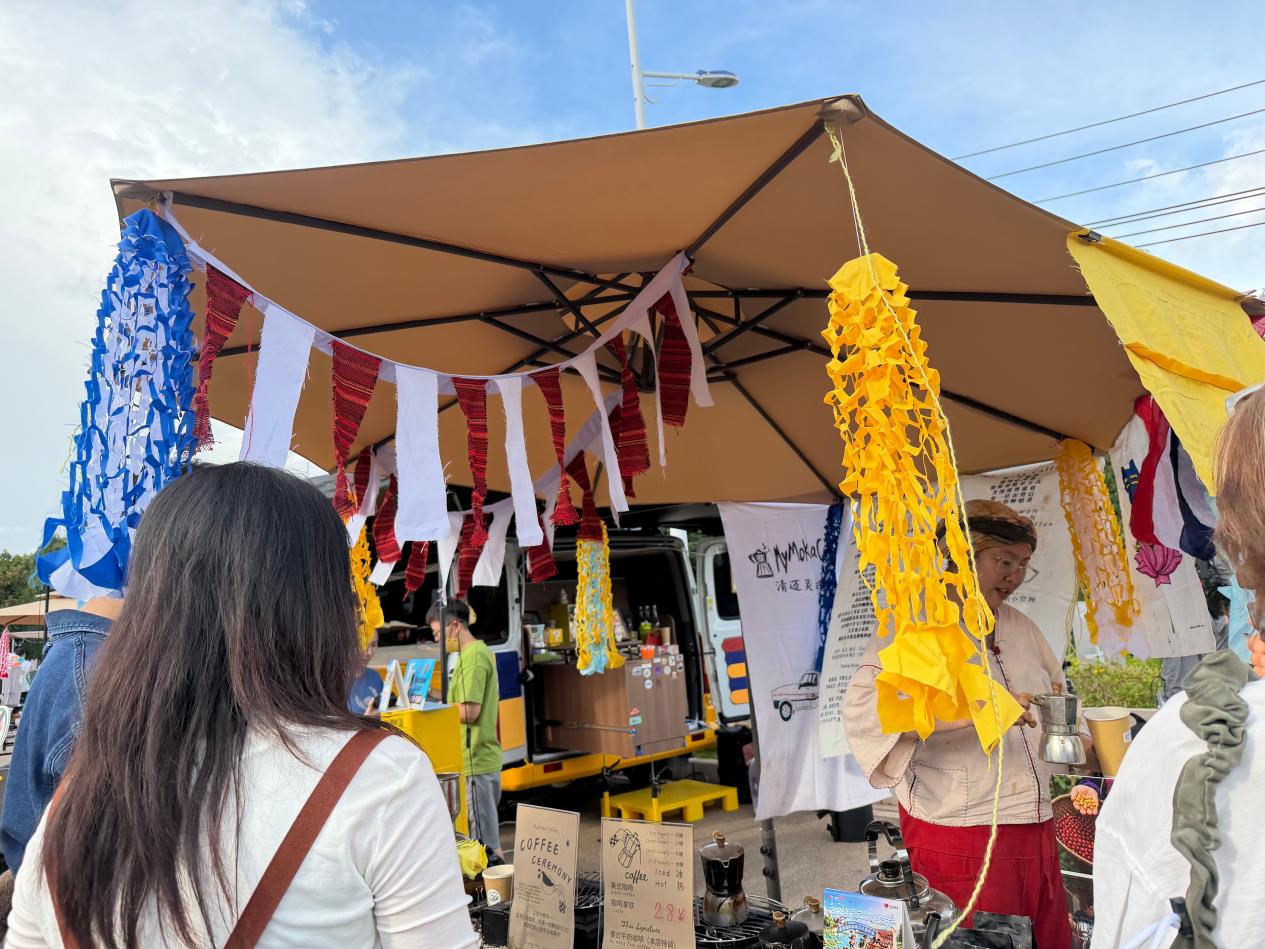
Mhaa's booth, where hand-woven cloth in red, blue, and white hangs as curtain banners, swaying gently in the breeze. Photo by Tan Shiyan/Reporter
Her booth is "My Moka Coffee," hailing from Chiang Mai, Thailand. The sign bears a gentle brand motto — "A Soulful Creation from Chiang Mai." There are no flashy machines, no elaborate decorations. Two canvas banners hang on either side: one tells the story behind the brand, the other reads "A Coffee Story from the Mountains." A hand-cranked coffee grinder bears the wear of years of use; a kraft paper menu lists drinks and prices. Beside it, a display board offers details about the coffee beans sourced from Doi Chang. The whole stall feels like a corner transported from the hills of Chiang Mai — simple and unadorned, yet filled with a quiet, heartfelt warmth.
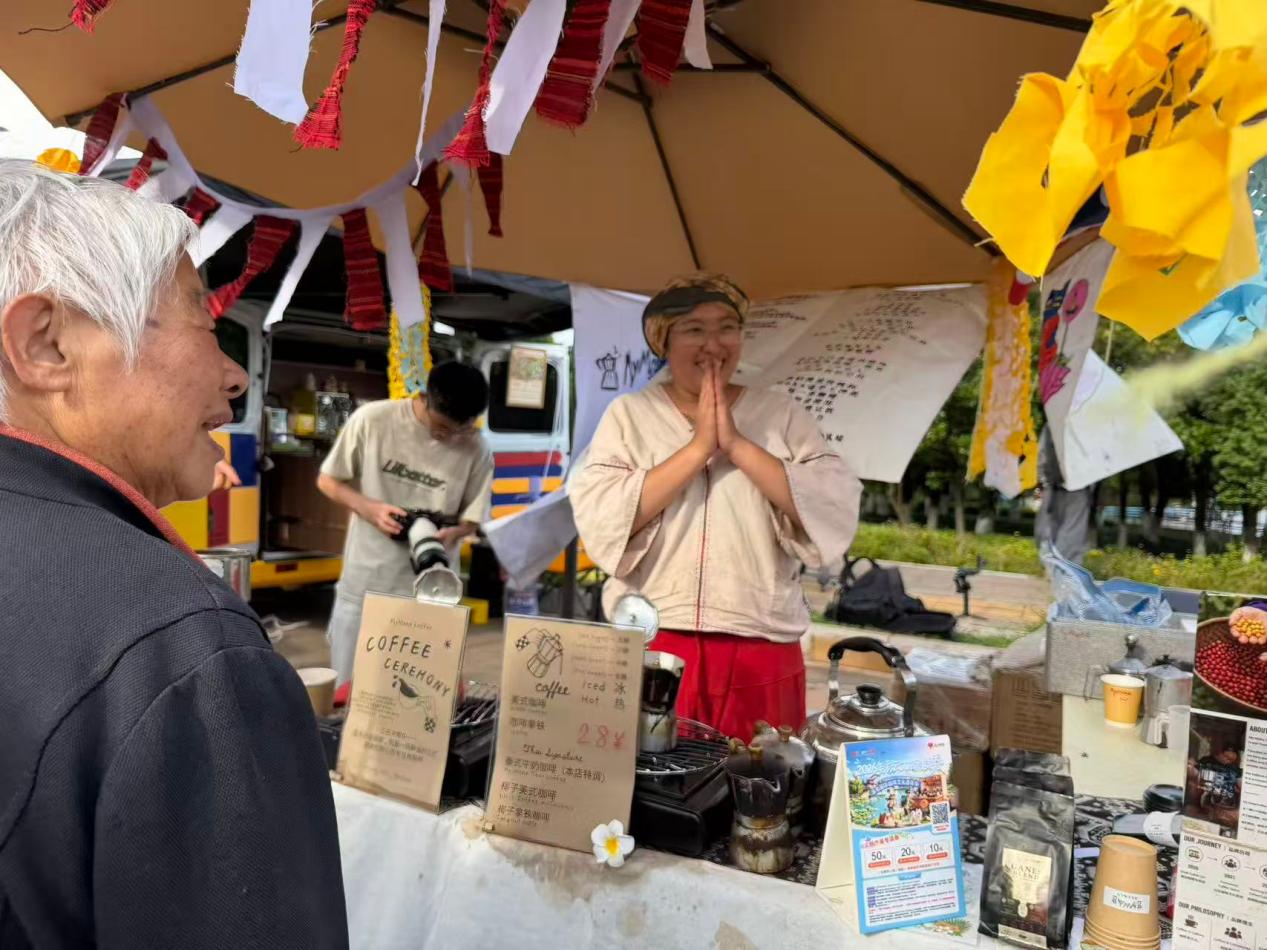
An elderly visitor with silver hair pauses at the booth as Mhaa greets him with a traditional Thai wai and a smile. Photo by Tan Shiyan/Reporter
"Sawasdee ka." When someone stops by, Mhaa brings her palms together in greeting and smiles. With each cup, she takes her time weighing the coffee, pouring in the water, then quietly waits as the moka pot slowly releases the coffee. When visitors ask about the beans, she picks up a sample bag from the table and points to the farm pictured on it, explaining softly: "These beans come from my family's highland farm. They're organically grown."
This slowness is precisely what makes her coffee so special.
All of Mhaa's beans come from her family's farm in the Doi Chang mountains of Chiang Mai, where generations of her family have been growing Arabica coffee for decades. The region lies within a Geographical Indication (GI) protected area, follows organic farming standards, and uses the traditional washed processing method of the mountains — every step done by hand by local farmers. This interview was conducted in English, and Mhaa spoke with earnestness about this commitment: long ago, before electricity reached the mountains, people relied entirely on hand-making to brew coffee. She insists on manual brewing with a moka pot and grinding beans by hand precisely to preserve this most traditional flavor — no reliance on electricity, no rush for efficiency, only the most authentic taste of coffee.
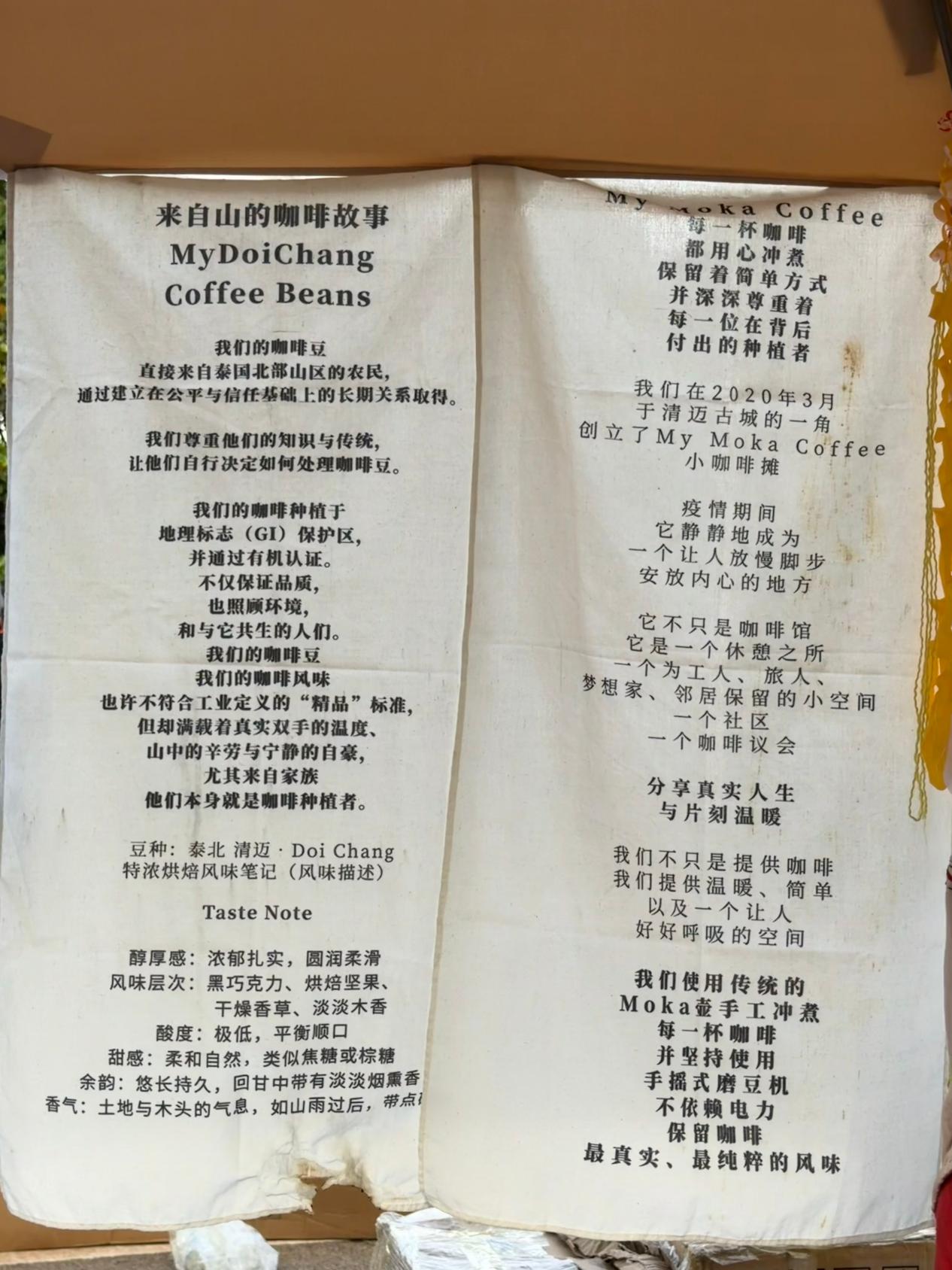
The themed canvas banner hanging at the booth records the farming philosophy of Doi Chang coffee beans and the brand's founding vision. Photo by Tan Shiyan/Reporter
This slower way of making coffee also marked a turning point in Mhaa's life. During the pandemic in 2020, Mhaa lost her previous job, so she set up a tiny coffee stall on a street in old Chiang Mai. "At that time, I felt so small. I didn't know if anyone would appreciate what I was making," she admits. In the hardest moments, it was the coffee she brewed cup by cup that carried her through. From a roadside stall to a small shop in an alley, My Moka Coffee has been running for seven years, gradually becoming a little gathering spot for local office workers, travelers, and neighbors. "It's not just a coffee shop — it's a place where people can rest, a warm little community." Those words, printed on the banner, are exactly what she believes a coffee shop should be.
Her connection with Kunming began three years ago, when she was invited to the Dianchi International Coffee Culture Carnival. The first time she stood at the market by Dianchi Lake, she fell in love with the city. "Kunming really feels like my second home." Returning this year, regular customers she met last year always make a special trip to see her — some learn a few words of Thai just to greet her, others bring local Yunnan beans to exchange and compare flavors.
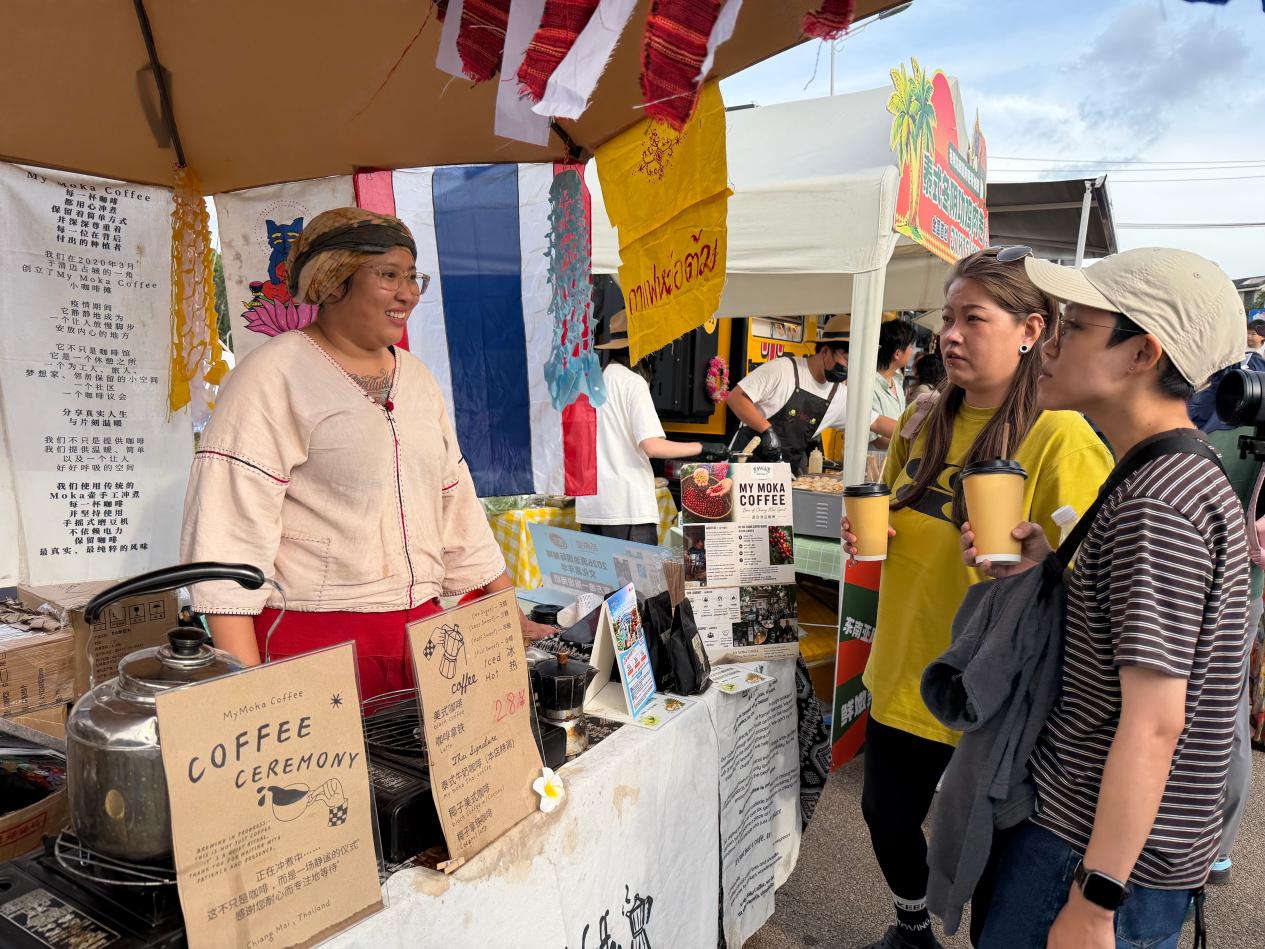
At the My Moka Coffee booth, traditional brewing utensils are lined up as Mhaa chats with a visiting friend. Photo by Tan Shiyan/Reporter
During a break in the interview, two young women walked up to the stall and greeted her with a cheerful "Sawasdee ka." Mhaa's eyes lit up instantly, and she responded warmly in Thai. The three of them chatted back and forth — from coffee flavors to the weather in Chiang Mai — across the small coffee counter, like friends reunited after a long separation. "It's like a cultural exchange. I practice my Chinese, they practice their Thai. It's so much fun," she says with a laugh. Every visit to Kunming brings her so much encouragement; when she returns to Thailand and recalls these moments of kindness, she feels that what she does is full of meaning.
In her philosophy, coffee is never just a drink. "Every cup of coffee is brewed with care and simplicity, and carries deep respect for the growers behind the beans." Those words, printed in the most prominent spot on the banner, are the principle she has always upheld.
Her beans are sourced directly from mountain farmers, with no middlemen involved, building long-term partnerships based on trust and fairness. She does not force farmers to abandon their traditional growing methods; instead, she chooses to preserve this wisdom passed down from the land. For this reason, her coffee may not meet the industrial definition of "specialty coffee," yet it carries the warmth of hands and the breath of the mountains — rich and full-bodied, with caramel and nut sweetness on the finish, and a faint smokiness and herbal aroma lingering in the aftertaste.
"Even in Thailand, there's no coffee festival on this scale, with more than a hundred coffee shops coming together," Mhaa says with admiration of this year's Dianchi International Coffee Culture Carnival. In her view, this grand event is more than a gathering of coffee professionals; it is a bridge where cultures from different regions meet. Every year she brings her own beans to Kunming, and returns home with a bag full of local Yunnan beans. This back-and-forth is an exchange of flavors, and a meeting of cultures.
As the sun began to dip, the crowd at the booth remained steady. Mhaa picked up the moka pot once more; its surface reflecting the evening light, and the coffee slowly rose in the pot, its aroma drifting on the wind. When asked whether she would come again in the future, she nodded without hesitation: "As long as I have the chance, I will definitely come back. No one can predict the future, but I’m always ready to make the journey here."
For her, this coffee journey across mountains and seas has long been about more than just business. It is a meeting of the mountain winds of Chiang Mai and the clouds drifting over Dianchi Lake; an encounter between unhurried craftsmanship and genuine kindness. And every cup of moka coffee placed in a guest's hands is a warm letter from Chiang Mai.

八月的滇池岸畔草木葱茏,2026滇池国际咖啡文化嘉年华的市集里飘着交错的咖啡香气。在一众展位中,一顶素色遮阳棚格外特别:红蓝白三色手工织布垂成帘幡,风过时轻轻晃动;桌布织着泰国传统纹样,银亮的老式摩卡壶在便携炉上发出细密的滋滋声,摊主玛哈(Mhaa)戴着布艺头巾,正俯身调整炉具火候,手腕上的动作从容又专注。
她的展位是“My Moka Coffee”,来自泰国清迈,招牌上写着一句温柔的品牌语——“清迈灵魂之作”。没有炫目的设备,没有繁复的装饰,两张帆布挂布分置两侧,一面印着品牌的初心故事,一面写着“来自山的咖啡故事”;手摇磨豆机带着常年使用的磨痕,牛皮纸菜单上写着饮品与价格,旁边立着展板,细细介绍自家多伊昌(Doi Chang)产区的咖啡豆。整个摊位像一块从清迈山间搬来的角落,质朴却带着沉甸甸的温度。
“萨瓦迪卡。”见有人驻足观望,玛哈双手合十笑着问候。制作每一杯咖啡,她都慢慢地称量、注水,静静候着摩卡壶缓缓渗出咖啡液。遇到有人询问咖啡豆,她拿起手边的咖啡豆展示袋,指着上面的农场图片慢慢介绍:“这是我家高山农场的咖啡豆,有机种植的。”
这样的慢,正是她的咖啡最特别的地方。
玛哈家的咖啡豆全部产自清迈多伊昌山区的家族农场,几代人种植阿拉比卡咖啡已有数十年历史。产区地处地理标志(GI)保护区,遵循有机种植标准,沿用山里传统的水洗处理工艺,全程由当地农户手工完成。本次采访以英文进行,玛哈说起这份坚持时语气认真:很久以前,山里还没通电,想喝咖啡,人全靠手工制作。她坚持用摩卡壶手工冲煮、用手摇磨豆机磨豆,就是想留住这种最传统的味道——不依赖电力,不追求效率,只保留咖啡最本真的风味。
这份“慢”,也是她人生的转折点。2020年疫情期间,玛哈失去了原本的工作,便在清迈老城的街边支起了小小的咖啡摊。“那时候我觉得自己特别渺小,不知道自己做的东西会不会有人认可。”她坦言,最艰难的时候,是一杯一杯煮出来的咖啡撑着她走下去。从路边小摊到巷弄小店,My Moka Coffee一开就是七年,渐渐成了当地上班族、旅人与邻居歇脚的小据点。“它不只是一家咖啡店,更是一个能让人歇脚的地方,一个有温度的小社区。”挂布上的这句话,正是她心里咖啡店该有的样子。
与昆明的缘分,始于三年前受邀参加滇池国际咖啡文化嘉年华。第一次站上滇池边的市集,她便喜欢上这座城市。“昆明真的像我的第二个家。”今年再度赴约,去年就认识的老顾客总会专程过来,有人会特意学几句泰语和她打招呼,有人会带着本地的咖啡豆与她交换风味。
采访间隙,便有两位年轻姑娘走到摊前,笑着对她说“萨瓦迪卡”。玛哈眼睛一下亮了,立刻用泰语热情回应,三个人你一言我一语,从咖啡口味聊到清迈的天气,隔着小小的咖啡台,像久别重逢的朋友。“这样就像文化交流一样,我练中文,她们练泰语,特别有意思。”她笑着说,每次来昆明都能收获很多鼓励,回到泰国再想起这些善意,便觉得自己做的事充满价值。
在她的理念里,咖啡从来不只是饮品。“每一杯咖啡,都以用心、质朴的态度冲煮,也深藏着对咖啡豆背后种植者的敬意。”这句印在挂布最显眼处的话,是她始终坚守的原则。
她的咖啡豆直接对接山区农户,不经中间商,以信任与公平为前提建立长期合作;她不强行改变农户的传统种植方式,而是选择守护这份来自土地的智慧。也正因如此,她的咖啡或许不符合工业定义的“精品标准”,却带着双手的温度与山间的气息——醇厚扎实,尾调有焦糖与坚果的甜,余韵里藏着淡淡的烟熏与草木香。
“就算在泰国,也没有这么大规模的咖啡节,能有上百家咖啡店聚在一起。”说起本届滇池国际咖啡文化嘉年华,玛哈连连赞叹。在她看来,这场盛会不只是咖啡从业者的聚会,更是不同地域文化相遇的桥梁。她每年带着自家的咖啡豆来昆明,回去时行囊里总装着云南本地的咖啡豆,这一来一回,便是风味的交换,也是文化的相拥。
日头渐斜,摊位前的人潮依旧络绎不绝。玛哈又一次拿起摩卡壶,壶身映着傍晚的天光,炉上的咖啡液缓缓上升,香气漫开在风里。有人问她未来还会不会来,她毫不犹豫地点头:“只要有机会,我一定会再来。未来的事没法预料,但我随时都做好了奔赴这里的准备。”
对她而言,这场跨越山海的咖啡之约,早已超越了一门生意。它是清迈山间的风与滇池畔的云的相遇,是慢下来的匠心与真诚的善意的相逢。而每一杯递到客人手中的摩卡咖啡,都是一封来自清迈的、温热的信。

